
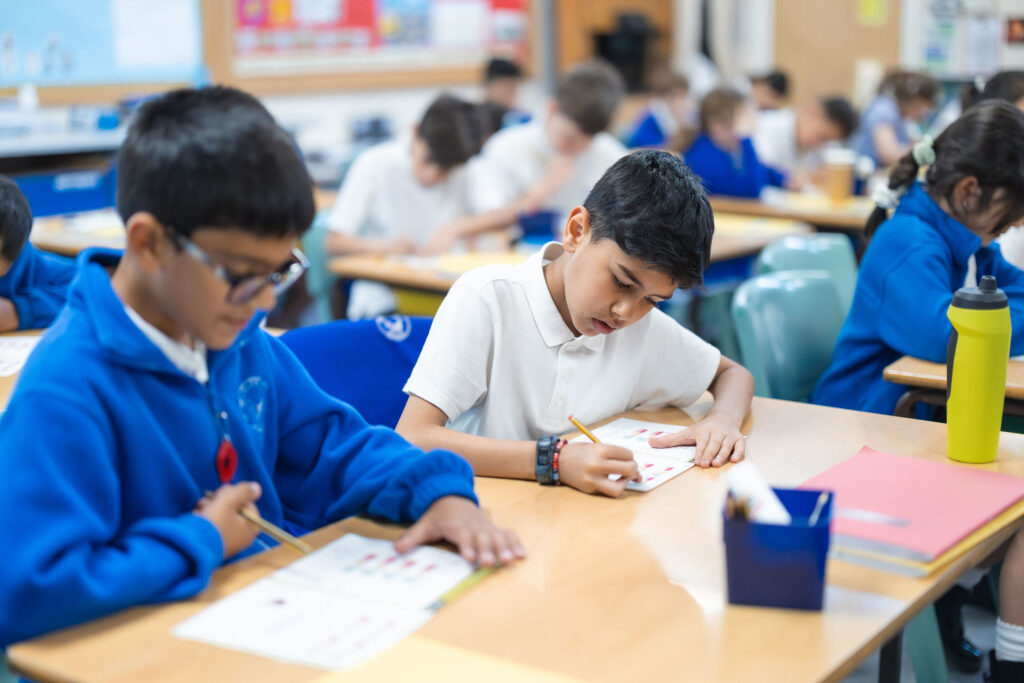
Year 4 Learning Journey
Welcome to Year 4 with Miss Pierides and Miss Bennett
Summer Term Topics
English
Learning
In Summer 1, children will be writing a narrative with a setting description based on a music video. They will also write a biography about a musician which they research.
In Summer 2, children will be working on their persuasive language to create posters about ocean pollution. After that, they will be writing their own adverts for a water sport to convince people to join their club.
The books we will be reading this term: Journey to Jo’Burg by Beverley Naido and Race to the Frozen North by Catherine Johnson.
Your child will be reading regularly as part of their whole-class reading sessions and independently reading daily, encouraging reading a range of genres, including non-fiction text, from the class book corner or a book of their choice from home.
How you can help at home
Talk about our topics. Any additional research will make them better writer! Practise looking up words in a dictionary and choosing the relevant meaning.
Reading for at least 30 minutes each day makes a huge difference.
Talk about new and interesting vocabulary that they come across and make sure they understand the meanings. Use a dictionary to look them up.
Encourage them to use new vocabulary, especially words related to the topic.
They have started editing their work so any work completed at home please encourage children to re-read and rectify any mistakes made or explore ways it can be improved.
Make sure that anything they write is in joined up handwriting (except for capital letters), the spelling is correct and the sentences make sense. Practise makes permanent.
Spelling
Learning
Spelling is taught three times a week.
Following the No Nonsense Spelling scheme, Year 4 spellings further what they learnt in year 3 by the further use of prefixes and suffixes, a wider range of homophones, words that are often misspelt and using possessive apostrophes for singular and plural words. Children are taught to use the first 2 or 3 letters of a word to check its definition or spelling in a dictionary.
Spelling tests take place once a week on Fridays in the form of simple sentences dictated by the teacher.
How you can help at home
Practice the Year 3 and 4 statutory spelling words as well as the words they have been given for their spelling tests.
Discussing the meaning of any new word your child comes across while reading or in their spellings.
Maths
Learning
The topics we will be covering this term are:
- Decimals A
- Decimals B
- Money
- Time
- Length and Perimeter
- Statistics
- Position and direction
Please visit the White Rose website, where you can find videos to recap their learning.
Children will be working on their times tables ahead of the statutory Year 4 Multiplication Tables Check in June.
Each week, they will be challenged on their times tables. They will complete 30 questions on a specific times tables, in 5 minutes. To pass and move onto the next challenge, they need 30/30. After they complete six challenges, they will receive a badge in assembly. This is a Monkfrith School Challenge that they will continue through to Year 6. Children can be quite competitive and it has been a successful way to get children to learn their tables.
How you can help at home
It is vital that your child knows how to tell the time on an analogue clock as this is a year 1, 2 and 3 objective. Please ask them the time daily.
It is helpful if you are out shopping to look at prices of items, compare them, add them and find the change.
Monkfrith encourages them to learn all their tables through the weekly times table challenge. Times Table Rock Stars is a great way to learn their tables and it records the facts they know and do not know. https://play.ttrockstars.com/ We find this is a hugely beneficial tool for learning tables and helps them enormously with the Year 4 curriculum. The soundcheck game is a copy of the Multiplication Tables Check.
MyMaths.co.uk homework will be set weekly but can also be used anytime to practise anything they have learnt.
A couple of websites with Maths games:
https://www.topmarks.co.uk/maths-games/hit-the-button
https://mathsframe.co.uk/en/resources/category/22/most-popular
If your child enjoys song, try learning times tables through these songs:
Wider Curriculum Learning
Learning
Playlist
In Summer 1, our topic is mainly science based and the children will learn about how sounds are made and how the ear works. They will look at the work of Kandinsky and create their own abstract art inspired by music.
Blue Abyss
In Summer 2, our topic is mainly geography and science based. The children will learn about the different bodies of water around the globe and consider the impact of water pollution.
They will learn how to classify living things and use a classification key to identify the living thing.
In DT, they will make a moving cam toy inspired by the ocean.
How you can help at home
Each week on the homework, we include a talking homework question related to our topic.
Playlist
Visit the local library to find non-fiction books about sound. Look for information using contents, glossaries and index pages. Write down any new facts they have learnt. Explore different sounds. How does it travel? Does it travel through different materials? What happens to sound as it travels further away from the source? Discuss pitch of a sound and features of objects that produced it. Discuss volume of a sound and the strength of the vibrations that produced it.
Blue Abyss
Visit the local library to research the bodies of water and ocean layers. Use atlases to locate countries, towns, bodies of water. Look at keys and identify key aspects of physical geography. Discuss their local area. Use digital maps to locate local places they recognise. Discuss living things from the sea. Sort and classify living things into the six main animal groups: mammals, reptiles, amphibians, birds, fish and invertebrates. Discuss food chains and classification keys to help identify the living thing.
PSHE
Learning
The topics we will be covering this term are:
- Stereotypes
- Peoples’ roles in their community
- Managing money
- Healthy and unhealthy friendship
- Drug education – alcohol and decision making.
The children will also have separate RSE lessons to learn about the changing of their bodies during puberty.
How you can help at home
Encourage your child to discuss their feelings, share their concerns and pressures they may feel throughout the year.
It might also be beneficial to discuss budgeting and savings with them, if you haven’t already, as this knowledge will enable their future financial choices.
RE
Learning
This term we will be studying a Big Question that develops an understanding of what different religions and worldviews teach about what is real and what is not. They will build on what they have learnt previously about reality and compare the perspectives of different religions including Christianity and Dharmic faiths.
How you can help at home
Open-mindedness to these topics will only benefit your child’s understanding of them.
Music/Spanish
Learning
The children receive music lessons weekly.
The children receive Spanish lessons weekly for half a term with a specialist Spanish teacher.
How you can help at home
Listen to music with them, talk about what you like, dance to music with them, sing with them. It doesn’t matter if you think you have no musical skill (you do, by the way, everyone does!) just let them see you enjoying music and their enthusiasm will sky rocket!
PE
Learning
Summer 1 – Athletics
Summer 2 – Rounders
4B PE lessons will usually take place on Wednesdays.
4P PE lessons will usually take place on Wednesday/Thursdays.
How you can help at home
PE kit should be in school at all times and clearly labelled with your child’s name. For safety, long hair should be tied back for all sporting activities. Earrings will need to be removed during physical exercise; if ears have recently been pierced, they should be taped. Children who are well enough to be in school are expected to take part in PE activities.
Computing
Learning
In Summer 1, children record and edit their own podcasts based on a poem or rap of their choice. They work in groups to create a performance before adding sound effects by cutting, trimming and layering sounds using computer software.
In Summer 2, children create their own ocean themed racing game using simple algorithms which they learn to debug as issues arise. Their coding includes sequence, repeat function and variables.
How you can help at home
Please talk to them about the importance of being safe online. Ask them to tell you the Monkfrith online safety rules. Ensure that they are using these rules at home too. The following websites have more information and advice for parents on how to help your child stay safe online.
- https://www.thinkuknow.co.uk/
- http://www.kidsmart.org.uk/
- http://www.netsmartzkids.org/
- https://www.saferinternet.org.uk/
Algorithms can be used every day when giving or following instructions and directing objects, not only through online games but with describing the movements of practical objects.
Encourage them to use word processing software and a keyboard to improve the speed and accuracy of their typing.
This website teaches them how to use all their fingers on the keyboard: https://www.bbc.co.uk/bitesize/articles/z3c6tfr#zf8yg2p
Homework
This will be set on a Friday on Google classroom and should be handed in by Wednesday.
It will consist of spellings to practise, maths and something related to our topic. If the piece of work is project based, it may extend across several weeks.
We also expect each child to do:
- 30 minutes of independent reading every day! Note: Children are far more likely to read for pleasure when they see their parents doing so as well, even if it’s for a short while.
10 minutes mental maths/times tables everyday (By the end of Year 4, children are expected to know ALL their times tables. They will continue the Monkfrith times table challenge each week).
